Showing posts with label Caffe Strada. Show all posts

Sunday, October 31, 2010

halloween hyperreal

I just offered this up on Twitter, because, well, it's true, of course:

Standing in line at a cafe on a bright autumn day, my eye scans the scene and is immediately drawn to...a lit computer screen. #hyperreal.
On this Halloween afternoon at Strada, where the Jolly Green Giant walked by with a nonchalant air as I was locking up my bike, when you're given permission to be a side of yourself who is actually someone else, I'm tempted back to the ideas of Umberto Eco, Jean Baudrillard, and myriad others who probably have thought such things but whose ideas weren't published in the 'right' form, the idea of the hyperreal, "absolute unreality as real presence".

But I'm not feeling it in the occasional Halloween costume that saunters by, as much as I am in the ubiquitous medium that populates cafe tables, desks at home, offices, and indeed people's pockets: screens. Screens, the rectangular, shimmering surfaces into which we peer, to which I've paid my homage to before on this very blog (saying the same thing this time? Perhaps...), the 'windows' that Anne Friedberg has done much to describe in her recent book, too.

I'm not sure if there's a profound statement to be made about this today, just a noticing, a marking, of how easily, how naturally, my eye is drawn to them, as are the eyes of others, to those spaces where reality seems somehow so much more real, or is it enabling, than the plain old blue sky and yellowing leaves on these patio trees. Is it strange that this day of costumes should be an occasion for seeing screens, as opposed to looking directly at what lies within them?

Tuesday, September 14, 2010

weekend millings at strada

The last few weeks I've started carrying around an audio recorder on the weekends, to capture hourlong to-be podcast pontifications with longtime buddy Ray in the form of the new 'radio' show, Talkin' Trash with Ray & Dave (Facebook page here). Tongue firmly in cheek, which, as far as I see it, is pretty much where it should be all the time...

But carrying a recorder around with me is something that I've always meant to do anyway. We collectively spend so much time looking at and taking pictures, that it seems to me that photos end up as the default and normative media-type stand-in for our memories. Wherever you go, if you want to remember it, you should first and foremost remember to take your camera, pose for the camera, and take a picture. Maybe a video if you've got the equipment and wherewithal, and maybe a series of photos if you want to capture various aspects, different people, different angles...

But for me the sounds of a place are perhaps more evocative of the place than are the sights; for some reason, experiencing the sounds as they unfold again in time can transport me to that place in my mind, while at the same time not allowing me to affix labels so easily, to categorize, tag, and stash away in some box in the mind, as I feel I do with photos.

Sure, I'm being over-dramatic here, but I do think that audio recordings of place, phono-graphs of sorts, deserve a better place in our own everyday media practices. And, as I look around thinking about buying a handheld recorder that will hopefully be somewhat faithful to the sounds without breaking the bank or requiring tons of equipment (looking at the Zoom H1 now), I'm hopeful that, just as carrying a camera helps me to see, carrying an audio recorder around will help me to listen, to be present and attuned to where I am.

For starters, here's a 40-minute recording from a few days ago, weekend millings at Caffe Strada, one of the favorite spots here on CN. Click the link to go to the audio file:

weekend millings at strada

Thursday, August 12, 2010

smooth space in strada?

Has it really been three weeks or so since the last post? Much has transpired since then, much time spent offline and much online time spent on sites like Twitter and Facebook where the turnstiles move much more quickly than here. But it's liberating to be able to write even that last sentence, which I'm guessing might tip the scales at over 140 characters. Which makes me think, ironically, of a great tweet: "Blogging on an honest-to-goodness blog like taking off one's shoes and stretching out at the end of a long day". Though I might have to remove some of the intermediary verbiage.

Today I feel like I both want and need this space (is there an English word that encompasses both 'want' and 'need'? how many songs can you think of that put these two into sequence, usually in that order--"I want you, I need you, I love you...") as a place to blow off steam as I try to trudge through 600 or so words on the article-that-is-dissertation chapter I'm working on, on the interface. For the last week or so I've been tossing around some ideas on Deleuze and Guattari's concepts of smooth and striated space, and today's one of the days when we'll see if we can make something happen with it.

Perhaps a little academic liveblogging? This is as much exercise for the fingers and the mind that it is actual writing--these words are quire devoid of content, but, then again, who actually reads this blog anyway?

  • 2:42pm.

Wednesday, April 21, 2010

some transcaffeinated techniques of disciplinary marking

Here the title of the post makes a promise that the body won't be able to deliver; that much I know. I'm sitting marking papers for a Berkeley class on Language & Power, and as I work my way through the stack I'm starting to notice some--what shall I call them--eccentricities in my grading tendencies.

Perhaps you've experienced this, too, if you have a job that is composed of repeating the same procedure a discrete number of times, each of which seems like a job unto itself, the completion of which seems deserving of celebration, taking a break and, yes, procrastinating from the next one by starting on a blog post.

In the class, we've been reading Deborah Cameron's Good to Talk?, where she decries the way that language has become commoditized and made into a tool of worker empowerment and self-realization, corporate branding, and object of therapeutic intervention: learn to talk better, and you'll be more in touch with yourself and more able to smooth out any 'misunderstandings' that might be plaguing you in your home and work life. And students are being asked to relate this back to Foucault, whose notions of discipline as a socially normalizing force that is internalized and exercised by individuals upon themselves, from Discipline and Punish, are key for thinking about how language is being used.

But actually, as I sit here plowing through a pile of papers (sorry, kiddies, I luv u just the same! :), I'm thinking more about Foucault's invocation of Borges' bizarre taxonomy that he calls the "Chinese encyclopedia"--an example of the kind of assemblages of radically different kinds of things into a single list or category or other form of association, for reasons that are totally befuddling to the outside observer.

What spurred this thought? Well, as embarrassing as this may be, I guess I'll just have to go ahead and write some of the things going through my mind as I'm grading, deciding not what grade to give on a certain student response (although I'm thinking about that too, but that's work), but which paper to grade next, and just how much progress I'm making (or not) as I grade.

Now, I present a procedure for grading a stack of papers, foregrounding principles of logic and efficiency. That is, basically a taxonomy of random thoughts that, together, help me make it through the pile:
  1. First grade those papers that are not stapled together, so as to remove them and their potential for decomposition and confusion from the pile. Try not to blame the student for not having a stapler or access to a stapler (though I'd be lying if I said that thoughts like this didn't float through the mind on a subconscious level)
  2. Then grade those papers in which students have not written the question prompts for their paragraph responses; these require more work as you have to refer back and forth to a printed copy of the questions, or, to save time, another 'more diligent' student's response sheet with said questions written down.
  3. Count papers frequently, preferably after each is graded, to make triple sure that you haven't over-estimated in your mind the number of papers remaining to be graded. Arrange them all in a neat stack after counting. 
  4. Extending point #2, give slight preference to those papers where students have put the question prompts in bold (better) or italics (still good).
  5. Give slight preference to non-Times New Roman fonts. Such papers give the impression of being attended to more carefully than those with the default, though this is a theory that is often disproved. The point, though, is that there's a curiosity that goes along with discovering whether the student has unusually witty responses, that makes the task of grading somewhat more tolerable.
  6. Try not to look back at the stack of papers too frequently. But do feel the pile of completed papers as it grows. For added pleasure, pick up the pile frequently in your hand. Weight = accomplishment. 
  7. Save for last those papers that are printed only on one side with double spacing; they are thickest, quickest to read, leading to a rapid sense of progress as the pages can be turned more quickly and the stack of papers depleted.
  8. No definitive statements can be made about papers that are longer or shorter, all other things being equal. Shorter responses often take longer to grade and, more often than not, require marginal comments. A definite timesink.
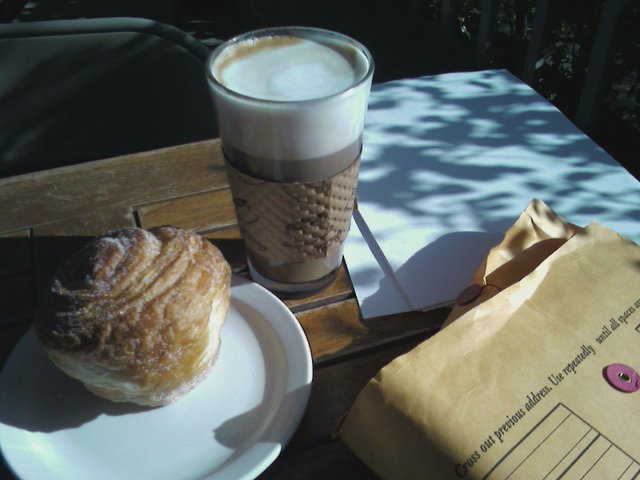
  9. Whatever you do, reward yourself frequently: stretching is nice. Checking email or Facebook updates is another option. But when things are really getting tough, you need to resort to ingestion. This post, for example, and the work that has gone into grading this pile of papers, has drawn on at least 2 pastries and 4 caffeinated beverages, from Strada, Local 123, and probably somewhere else too. But I'm repressing that thought now, because I still have 6 papers to go. I'll see if I can make it on this cappuccino...

    Wednesday, March 24, 2010

    from seconds to minutes...

    9:04pm. Last time it was all about the warm-up; tonight the pace is slower, the mood calm. I've done the obligatory surf before settling into grading, and now only plan on looking up from the papers at this table here at Strada when there's a 'bump' in the rhythm of the place.

    9:06pm. Soft piano rolling out of the open door, a smattering of people, a few on computers, and what are they doing over there across the way? Looks like playing cards. A guy has plugged his phone into the outlet outside to get a little juice, makes a quick call "Alright bro, I'll be waiting," finishes the call just as quickly, pulls out the plug, and disappears out through the other door. Quiet returns, the intermediate quiet of spring break...

    9:25pm. Bus passes. Was it the last #7? Why is Hacking's idea of kinds so hard to understand? What is it about the history of child abuse as a kind, and social construction generally, that's so hard to understand? When did I start to understand this stuff? Do I even understand it now?

    9:51pm. At what point when you're sitting in a really quiet place do you start hearing other ambient noises? Suddenly, the sound of the heaters overhead. Have they been on the whole time??

    9:53pm. Rain. Or, let's call it mist. First microscopic drops on the right side of my neck and they make me wonder, is it my tight back and bad posture that's making my nerves go off? But, no, not at all...within a minute, the sound of actual raindrops falling on leaves...and the thought, not a great night for biking home.

    10:15pm. “Disciplinary power … is exercised through its invisibility; at the same time it imposes on those whom it subjects a principle of compulsory visibility. In discipline, it is the subjects who have to be seen. Their visibility assures the hold of the power that is exercised over them. It is the fact of being constantly seen, of being able always to be seen, that maintains the disciplined individual in his subjection” (Discipline and punish, p. 187). Still sends shivers down my spine. Still raining.

    10:46pm. Staff packing up. I look around and there's nobody else outside. A car--a single car--drives down the street, tires making that sound that only wet tires make on a wet street. Is there a word for that sound? Swishing? Whooshing? Damn, language is so full of potholes. It's amazing we can drive.

    Sunday, March 21, 2010

    sunny sunday

    Strada is so photogenic! Coming down from running stairs in the afternoon sun at Memorial Stadium, it's hard not to be struck by the play of light off the branches and other objects in and around the cafe...


    Of course, these are just crappy cell phone pics, taken a few hours and pages of field notes after the mid-day run. Really ought to take real photos.

    And, in the meantime, the sun has set and the vibrancy of a just a few minutes ago has faded into shades of blue and grey, with the trees, tables, pillars, people awaiting the return of their friend from the east in just a few short hours...

    Thursday, February 25, 2010

    two degrees warmer

    3:30pm. A slight rise in the temperature, and they're out in force today. People bent over books and papers, pens in hand, lost in thought. A table of four people, lively conversation flowing and ebbing until someone gets a phone call and the traffic of words is diverted. The table next to me with two men in animated discussion about something, one tapping the other on the elbow with one hand, alternatively clasping his coffee and gesticulating with the other. The occasional table with someone just looking up, looking around, maybe noticing, enjoying the new green on the trees?

    5:18pm. I've been here now for approaching two hours. Still have conversations going on, still a rhythm to the place, but there are fewer shorts, fewer short-sleeve shirts, and voices more muffled. The blue above has been replaced, covered up with a veil of grey. Like the day couldn't decide whether it wanted to be spring or not...

    Monday, February 22, 2010

    that temperature

    There is a certain temperature at which the little yellow flowers (weeds) along the side of the roads in Berkeley just start to open up to the sunshine, while others stay closed, raised in anticipation. And that temperature must be within a degree or two of the temperature at which students decide that it's too cold to sit outside at Strada, even when white petals are falling from branches that bear new green leaves. Too warm to stay home, too cool for a t-shirt. The perfect temperature?

    Saturday, January 30, 2010

    the owl

    This guy’s head has been swinging around so much in the last 20 minutes, I swear it’s going to fall off. Seriously, WHAT are you looking at. Really. Stop it, why don't you, and look at your own damn screen.

    OK, relax, Dave. Perhaps some background information is in order. The guy sitting next to me at Caffe Strada has been sitting at the table next to me for like the last 30 minutes. Has his computer open, touch phone on the table charging from his computer, and occasionally types something. I haven’t done the little surreptitious glance over to the side to see what’s on his screen. You could call it manners, and that may be partly true. But partly it’s because he’s constantly looking over this way, and looking over at him would be pretty darn obvious.

    So while I was writing that paragraph he was actually somewhat focused, or at least it looked that way. Hadn’t looked up for at least 45 seconds until a group of Korean-speaking friends sat down talking at the table across from us. He straightens up, looking across my front, scanning...looking for someone? Waiting for friends? Scoping the scene? Animated by an other-worldly power as he ponders what to peck into his computer next?

    He looks back down at his computer, types a furious burst for about 5 seconds, and then looks straight ahead. To the right. Cocks his head and looks back straight. Rolls up his sleeves and then does a 150-degree swivel to look back over his left shoulder. Then back at his computer for 3 seconds and it starts again.

    Really, is this the physical embodiment of all of our attention spans these days? The wired and multi-channeled populace of digital beings, living at least as much through our devices than we do in the physical places where our bodies are placed? Reading my friend Juliette Wade’s recent post on the effects of technology, I’m reminded of how much we have had to adapt ourselves to the digital tools of our daily lives, as much as they have become “smart” and adapted to us. Really, is it necessary for me to have 6 tabs of Firefox open right now?

    He leans back and in one smooth motion pulls his laptop off the edge of the table and onto his stomach, and checks his messages on his phone with his left hand. Looks like nothing’s come in. Still. Meanwhile, as he pulls his hood up and looks left, straight, left, straight again, I instinctively downsize the MS Word document I’m typing this blog post into from 125% to 100%. Like he’s looking. Like he cares. But somehow I, with my multiple tabs open and my attention span that is splintered in 10 directions but all within the screen, am unnerved by this guy’s constant shifting of attention on screen, in the cafe [scan left], on screen, in the cafe [scan right], on the phone, in the cafe [straight ahead].

    I look at what I’ve written now, this post-to-be, about 500 words in just 5 minutes, that flowed out without my checking email even once.

    Wow, what just happened?

    [Scan left]

    Monday, January 11, 2010

    a short indiscretion

    Today's Facebook status update:
    Pecan roll from Cheeseboard, cappuccino from Guerilla, and banana, chair, table, wifi, electricity, view and ambience courtesy of Caffe Strada. Sorry Strada, I promise I'll make it up to you next time!
    I wouldn't recommend this on occasions other than the extraordinary, though...along with the obvious indiscretion involved, it's pretty dicey to bike while carrying a hot coffee drink.

    Saturday, January 2, 2010

    shades of interiority

    I was struck by something Charles said the day before about one of the charms of Caffe Strada being that there's an "inside", a "deep inside", a "sort of outside", and "outside". Or something like that -- anyone who's been there knows you can be as protected or as exposed as you'd like to be, sitting in booths inside, ordering drinks at the counter with its wide open doors and big windows, sitting under the covered (and more heated after some new installations in December, I think) patio area, and of course sitting under the canopy of trees in the outside patio, an oasis of sorts on the busy corner of Bancroft and College Avenues.

    There'll be a time to write more about shades of interiority, at this cafe and others. For now, I'll just post this series of photos from several hours sitting yesterday. First, looking in through the well-trafficked front door :


    And a shot looking inward from the edge of the seating area, along College Ave:


    Under the protected patio area. A cool and overcast day, and not many students here on January 2!


    Charlie taking a sip, sitting inside and outside.


    Peering a bit closer at the window...


    And a bit closer still:
     

    And arguably the most important space of the cafe, the space opened up by a full cappuccino.


    Thanks again to Gabriel and the other friendly barista and hand models at Strada on this day.